Friday, May 22, 2026
Good morning – welcome back to Wolmania. This week I have a multifaceted issue for your consideration. I think you'll find it illuminating!
Item 1: a link

Back in fourteenth century France, King Charles VI (“the Beloved") suffered from a very strange delusion.
For a few years, he had successfully managed the legacy of his father: the court, the factions, the English, the perpetual problem of money. Then he began to believe his body was glass. Not as a figure of speech for fragility or for the burdens of rule. He thought his body literally could shatter, refract light. As Pope Pius II chronicled: “Sometimes he thought he was made of glass and would not let himself be touched. He had iron rods put into his clothing and protected himself in all sorts of ways so that he might not fall and break.”
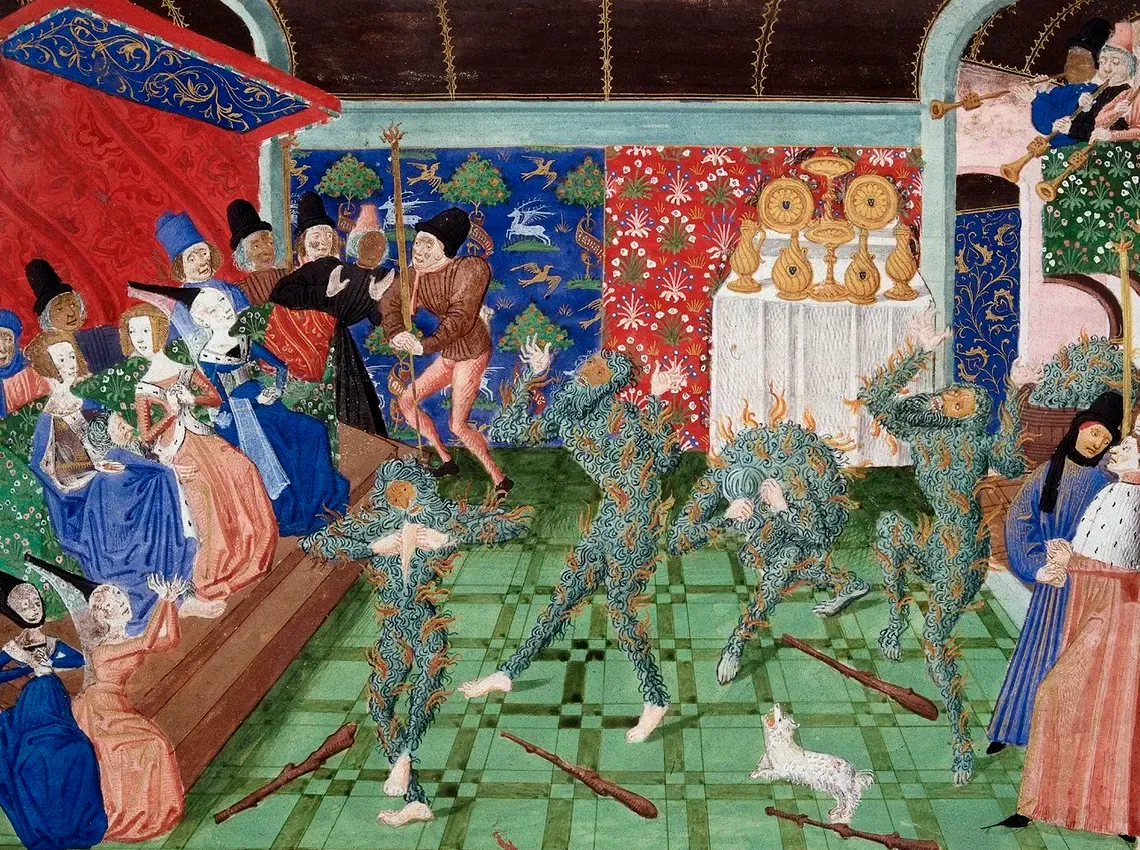
Charles was generally quite a mess. A few weeks earlier, he narrowly escaped death in a gruesome scene known as "the Ball of the Burning Men":
Weeks before the tailor’s commission, in a room not far from where he now worked, this same building had been on fire. It broke out during a winter masquerade: Charles and five nobles dressed as wild men, their linen costumes soaked in pitch, black and tarry, and studded with flax to look like hair. A spark, from somewhere. The pitch caught; they blazed. Four nobles burned to death where they stood. Charles survived only because his aunt, the Duchess of Berry, threw her skirts over him and smothered the flames. He stood in the ruined hall, the smell of burned hair everywhere, his skin unmarked, shaking.
A few months before that, seemingly spooked by a leper's prophecy of doom, he had some kind of spate of madness and killed several of his own knights.
Troubling stuff. But it got worse when the Glass Delusion started to spread...
Item 2: a list
Historical Glass Delusions, Ranked:
- The Dutch physician Levinus Lemnius, writing in the mid-sixteenth century, treated a patient who was rational and highly functional in every respect save one: the absolute conviction that his buttocks were formed from the same stuff as windowpanes.
- Somewhere around her twenty-third year — shortly after her father, King Ludwig I, was forced to abdicate in the scandal surrounding his mistress Lola Montez — Princess Alexandra Amalie of Bavaria developed the conviction that she had swallowed a grand piano made entirely of glass. Not that her body was glass, but rather that she contained it: the piano fully intact, its strings and hammers and frame preserved somewhere in her torso.
- In 1613, at the height of his fame — Don Quixote already published, its sequel underway — Miguel de Cervantes turned to a collection of twelve short stories. He called them exemplary novels: moral examinations of contemporary Spain, each one a different kind of problem. The eleventh was “El licenciado Vidriera”: the glass graduate. It told the story of Tomás Rodaja, a law student at Salamanca, brilliant and poor, working his way through on wit and borrowed scholarship. A woman falls in love with him. He doesn't return her feelings. She slips a love potion into a quince and Tomás eats it. When he finally surfaces from the fever that follows, he sits up and makes an announcement: “he was a man of glass and not of flesh and bones, since glass, being a substance of more delicate subtlety, permits the soul to act with more promptitude and efficacy than it can be expected to do in the heavier body formed of mere earth.”
- In The Optick Glasse of Humors (1607), cleric Thomas Walkington remembers a Venetian agoraphobic who feared that his “crackling hinderparts” would be salvaged by a glazier “to make the lights in a latticed window”.
- Charles VI: “Sometimes he thought he was made of glass and would not let himself be touched. He had iron rods put into his clothing and protected himself in all sorts of ways so that he might not fall and break.”
- The physicians André Du Laurens and Alfonso Ponce de Santa Cruz independently documented a nobleman who believed himself to be shaped specifically like a glass pitcher. Not merely made of glass, but also contained by it: he slept buried in straw, terrified that he might tip in the night and pour himself out across the floor.
- The Renaissance polymath Tommaso Garzoni documented a man who tried to throw himself into a glazier’s furnace and emerge as an inghistara, a long-necked jug without a handle.
- Du Laurens also recorded a patient who believed his feet were glass and who refused to walk.
Item 3: a media recommendation
Product 01 - Heart Ov Glass
Item 4: word of the week
Hyalography
I've been working for years on a massive book about the art of tattooing or, as King Charles IV called it, hyalography.
Item 5: an image
See ya!
Thanks for reading. Keep a watchful eye out for saboteurs and clumsy children... I'll see you in a couple of weeks.
Member discussion